

We say...
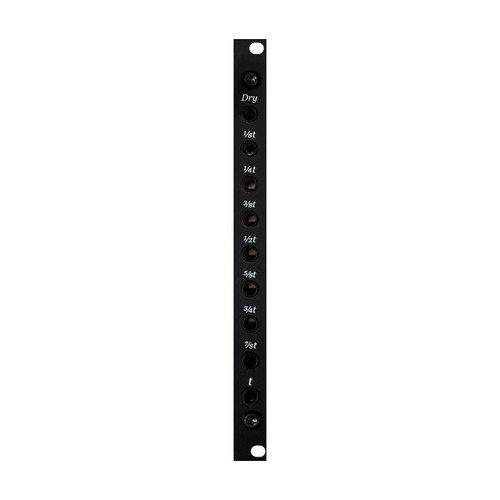
A pre-owned Music Thing Modular Turing Machine & Volts (x2) all in good condition with a little rack rash. They all come with power/expander cables.
Manufacturer's description
- The Turing Machine makes music for you. It's a binary sequencer, based around a 16 bit memory circuit called a shift register. It’s a sequencer that you can steer in one direction or another, not one that you can program precisely.
- You cannot program this sequencer to play specific tunes. You cannot save sequences. You can never go back to a sequence that has changed.
- To put it another way: the Turing Machine produces clocked stepped randomly changing control voltages. In other words, melodies, basslines, sequences. Unlike many random voltage generators, these sequences can be locked into loops that repeat according to the length control.
- The Turing Machine has become one of the most popular Eurorack DIY projects since June 2012. The #turingmachine tag on Instagram contains lots of great demos (and a certain amount of the real Alan Turing).
- This 27 minute video from DivKid explains everything you need to know about the Turing Machine and the expanders.
- And here's me talking for 20 minutes about how the Turing machine works and how it was designed.
- Here is a nice review of the Turing Machine from Sound on Sound Magazine
- Turing Machine Expanders connect to the back of the module, and take the sequence from the main module and use it in different ways:
- Volts adds an extra voltage output, with the sequence set by five pots.
- Pulses turns the sequence into beats: eleven rhythmic pulse-train outputs.
- Voltages adds two CV outputs controlled by 8 faders.
- Vactrol Mix is a sequencer controlled matrix mixer. It's fantastic for rhythmically cutting up audio, stereo panning and feedback loops, but a little hard to explain.
- In the Turing Machine, looping is controlled by the big knob.
- At noon, the sequences are random.
- At 5 o'clock, it locks into a repeating sequence.
- At 7 o'clock, it double locks into a repeating sequence twice as long as the 'length' setting.
- At 3 o'clock or 9 o'clock, it slips; looping but occasionally changing notes.
- You can try out a fully operational Turing Machine + Pulses + Volts in the free VCV Rack software
- Electronically, the circuit was inspired by the long history of shift register pseudorandom synth circuits, including the Triadex Muse, Buchla 266 Source of Uncertainty and Grant Richter's Noisering.
- Musically, the module was inspired by 60s and 70s minimalist process music by people like Steve Reich, Terry Riley or Philip Glass: “I am interested in perceptible processes. I want to be able to hear the process happening throughout the music.To facilitate closely detailed listening a musical process should happen extremely gradually.” Steve Reich, Music as a Gradual Process, 1968
- While designing the Turing Machine, I compiled this Random Reading List which includes notes on the history of random sequence generators from Marvin Minsky's Muse to Don Buchla's Source of Uncertainty to Doepfer's A-149 module.
- Tony Surgeon is a long-time Turing Machine user. In this workshop from 2016 he shows how he uses it to generate sequences which are then looped on an Octatrack.
- The Turing Machine is not a real Turing Machine the way Alan Turing explained it. The name is vaguely relevant because the module uses a loop of data being changed, but the similarity ends there. It's certainly not a 'probabilistic random sequence generator based on the research of Alan Turing' ;-).
How much is my shipping?
Shipping is automatically calculated before you submit your payment information. Simply add items to your cart and proceed to the checkout page, where you'll be offered shipping options and their prices. In the UK, 'next working day' shipping is free if the order value is over £150, and £5 otherwise. We can also ship on a 'next working day before 12pm' service, which costs £6 for orders over £150 and £7.50 for orders under £150.
Shipping to mainland EU typically costs between £7 and £20, depending on the shipping method and the size and weight of the order.
Do you ship to my country?
Almost certainly - the site will give you an estimate of shipping costs if you add an item to the cart and then enter your country and postcode. If you have specific requirements (such as if you prefer UPS over FedEx, for example) then let us know in advance and we'll try to work something out for you.
Shipping methods
We use a combination of DPD, Royal Mail and Parcelforce for the UK, and for international orders it's either DHL, FedEx, UPS, Royal Mail or Parcelforce depending on where you are in the world. If you have a particular preference then try to let us know BEFORE you order so we can look into it for you. Please note that there may occasionally be additional shipping charges if you live in a remote area, depending on what surcharges are applied by the shipper. We'll get in touch to discuss this with you in such cases.
Dispatch times
For UK orders, we aim to dispatch the same working day if we get the order before 16:00. If you have a really urgent situation then of course drop us an email before ordering and we'll always do our absolute best to accommodate you.
For international orders, we normally dispatch the same day if we get the order before 13:00 but again, occasionally it might be the next day before we can send it out, and sometimes the couriers may come to collect a little earlier than scheduled which would also push an order into the next day.
Saturday/Sunday shipping
If you're in the UK and you order before 16:00 on a Friday then we can send something for a Saturday or Sunday delivery with DPD. This is FREE for order values over £350, £5 for order values between £75 and £250, and £7 for order values under £75. (NB: this applies to UK mainland addresses only). Please note that any orders placed after 16:00 on a Friday will ship on the Monday.
International shipping times
Since April 2020, the couriers we use have suspended guarantees for shipping times, so even though we're paying them for priority services - 24-48 hours for most of the world - in practice it's often an extra day on top and sometimes it can be longer. There is absolutely nothing we can do about this, unfortunately. If you are outside the UK and it's a life-or-death situation where you absolutely MUST have that passive mult for the next day then... it may be better to find a local supplier.
Pre-orders
If a product is listed as a pre-order, it means we've ordered it from the supplier but it's not physically in stock yet. The product listing will include an estimated shipping date based on the best information we have from the supplier, but do bear in mind this is subject to change and is not a guaranteed date.
If you place an order containing a mixture of in-stock and pre-order items, we'll normally hold off on shipping anything until the pre-order item(s) have arrived, rather than splitting it into multiple shipments. If you need the in-stock items sooner, we'd recommend placing separate orders. As always, please get in touch if you have questions.
Product Overview
We say...
A pre-owned Music Thing Modular Turing Machine & Volts (x2) all in good condition with a little rack rash. They all come with power/expander cables.
Manufacturer's description
- The Turing Machine makes music for you. It's a binary sequencer, based around a 16 bit memory circuit called a shift register. It’s a sequencer that you can steer in one direction or another, not one that you can program precisely.
- You cannot program this sequencer to play specific tunes. You cannot save sequences. You can never go back to a sequence that has changed.
- To put it another way: the Turing Machine produces clocked stepped randomly changing control voltages. In other words, melodies, basslines, sequences. Unlike many random voltage generators, these sequences can be locked into loops that repeat according to the length control.
- The Turing Machine has become one of the most popular Eurorack DIY projects since June 2012. The #turingmachine tag on Instagram contains lots of great demos (and a certain amount of the real Alan Turing).
- This 27 minute video from DivKid explains everything you need to know about the Turing Machine and the expanders.
- And here's me talking for 20 minutes about how the Turing machine works and how it was designed.
- Here is a nice review of the Turing Machine from Sound on Sound Magazine
- Turing Machine Expanders connect to the back of the module, and take the sequence from the main module and use it in different ways:
- Volts adds an extra voltage output, with the sequence set by five pots.
- Pulses turns the sequence into beats: eleven rhythmic pulse-train outputs.
- Voltages adds two CV outputs controlled by 8 faders.
- Vactrol Mix is a sequencer controlled matrix mixer. It's fantastic for rhythmically cutting up audio, stereo panning and feedback loops, but a little hard to explain.
- In the Turing Machine, looping is controlled by the big knob.
- At noon, the sequences are random.
- At 5 o'clock, it locks into a repeating sequence.
- At 7 o'clock, it double locks into a repeating sequence twice as long as the 'length' setting.
- At 3 o'clock or 9 o'clock, it slips; looping but occasionally changing notes.
- You can try out a fully operational Turing Machine + Pulses + Volts in the free VCV Rack software
- Electronically, the circuit was inspired by the long history of shift register pseudorandom synth circuits, including the Triadex Muse, Buchla 266 Source of Uncertainty and Grant Richter's Noisering.
- Musically, the module was inspired by 60s and 70s minimalist process music by people like Steve Reich, Terry Riley or Philip Glass: “I am interested in perceptible processes. I want to be able to hear the process happening throughout the music.To facilitate closely detailed listening a musical process should happen extremely gradually.” Steve Reich, Music as a Gradual Process, 1968
- While designing the Turing Machine, I compiled this Random Reading List which includes notes on the history of random sequence generators from Marvin Minsky's Muse to Don Buchla's Source of Uncertainty to Doepfer's A-149 module.
- Tony Surgeon is a long-time Turing Machine user. In this workshop from 2016 he shows how he uses it to generate sequences which are then looped on an Octatrack.
- The Turing Machine is not a real Turing Machine the way Alan Turing explained it. The name is vaguely relevant because the module uses a loop of data being changed, but the similarity ends there. It's certainly not a 'probabilistic random sequence generator based on the research of Alan Turing' ;-).
Technical Specs
Shipping Details
How much is my shipping?
Shipping is automatically calculated before you submit your payment information. Simply add items to your cart and proceed to the checkout page, where you'll be offered shipping options and their prices. In the UK, 'next working day' shipping is free if the order value is over £150, and £5 otherwise. We can also ship on a 'next working day before 12pm' service, which costs £6 for orders over £150 and £7.50 for orders under £150.
Shipping to mainland EU typically costs between £7 and £20, depending on the shipping method and the size and weight of the order.
Do you ship to my country?
Almost certainly - the site will give you an estimate of shipping costs if you add an item to the cart and then enter your country and postcode. If you have specific requirements (such as if you prefer UPS over FedEx, for example) then let us know in advance and we'll try to work something out for you.
Shipping methods
We use a combination of DPD, Royal Mail and Parcelforce for the UK, and for international orders it's either DHL, FedEx, UPS, Royal Mail or Parcelforce depending on where you are in the world. If you have a particular preference then try to let us know BEFORE you order so we can look into it for you. Please note that there may occasionally be additional shipping charges if you live in a remote area, depending on what surcharges are applied by the shipper. We'll get in touch to discuss this with you in such cases.
Dispatch times
For UK orders, we aim to dispatch the same working day if we get the order before 16:00. If you have a really urgent situation then of course drop us an email before ordering and we'll always do our absolute best to accommodate you.
For international orders, we normally dispatch the same day if we get the order before 13:00 but again, occasionally it might be the next day before we can send it out, and sometimes the couriers may come to collect a little earlier than scheduled which would also push an order into the next day.
Saturday/Sunday shipping
If you're in the UK and you order before 16:00 on a Friday then we can send something for a Saturday or Sunday delivery with DPD. This is FREE for order values over £350, £5 for order values between £75 and £250, and £7 for order values under £75. (NB: this applies to UK mainland addresses only). Please note that any orders placed after 16:00 on a Friday will ship on the Monday.
International shipping times
Since April 2020, the couriers we use have suspended guarantees for shipping times, so even though we're paying them for priority services - 24-48 hours for most of the world - in practice it's often an extra day on top and sometimes it can be longer. There is absolutely nothing we can do about this, unfortunately. If you are outside the UK and it's a life-or-death situation where you absolutely MUST have that passive mult for the next day then... it may be better to find a local supplier.
Pre-orders
If a product is listed as a pre-order, it means we've ordered it from the supplier but it's not physically in stock yet. The product listing will include an estimated shipping date based on the best information we have from the supplier, but do bear in mind this is subject to change and is not a guaranteed date.
If you place an order containing a mixture of in-stock and pre-order items, we'll normally hold off on shipping anything until the pre-order item(s) have arrived, rather than splitting it into multiple shipments. If you need the in-stock items sooner, we'd recommend placing separate orders. As always, please get in touch if you have questions.